


Blog
Towel GSM Guide for Hotels and Spas
 March 11, 2026
 2 views
GSM is one of the fastest ways to compare towel weight when buying for hotels and spas. Used correctly, it helps balance guest experience, laundry turnaround, and cost per use. This guide explains what GSM means for towels, what it cannot tell you, and how to choose practical GSM ranges by application.
GSM Basics
What is GSM in towels?
GSM means grams per square meter. It measures how much a towel fabric weighs for a given area and often appears on spec sheets, product listings, and supplier quotes. When towels share similar construction, GSM is a reliable way to compare tiers. In general, higher GSM towels feel more substantial and hold more moisture, while lower GSM towels dry faster and move through laundry more efficiently.
How to calculate towel GSM?
You can calculate GSM with a simple sample-and-weigh method.
- Measure the sample length and width, then convert the area to square meters (m²).
- Ensure the towel is fully dry, then weigh the sample in grams (g).
- Use the formula: GSM = weight (g) ÷ area (m²)
Suppliers may report slightly different numbers for similar towels due to moisture content, compression of terry loops during handling, and finishing differences. If you reference a formal method for fabric mass per unit area, supplier documentation may cite ISO 3801.

What GSM does not tell
GSM is not a performance guarantee. Softness depends largely on yarn quality and finishing. Absorbency and drying speed depend on fiber choice, loop density, and your laundry process. GSM comparisons are most reliable within the same towel type and similar construction. A pool towel and a bath mat can share a GSM value yet perform very differently.
Same Gsm, Different…
Cotton and blends
Fiber content affects both feel and wash performance. Cotton is popular for comfort and absorbency, but quality varies and influences softness retention and linting. Blends can improve dimensional stability and may reduce drying time, depending on construction. The right choice balances absorbency, dry time, softness retention, and cost per use.
Yarn and loop structure
Because most hotel and spa towels are terry fabrics, yarn and loop structure matter as much as GSM. Ring-spun yarn often delivers a smoother hand feel and higher perceived quality, while open-end can be cost-effective and durable in certain builds. Ply can influence strength, but it should be evaluated with loop density and finishing. Loop density and loop height shape plushness, water holding capacity, and snag risk. Taller, looser loops can feel plush but may pull more easily in rougher environments.
Finishing and build details
Towels with the same GSM can wear differently due to finishing and construction. Borders and dobby designs can look premium but may dry differently and become wear points without proper reinforcement. Hem stitching and edge reinforcement reduce fraying and help maintain shape. New towels often lint, but excessive linting can signal yarn or finishing choices that cause ongoing issues. Shrinkage varies with fiber, finishing, and wash conditions. When evaluating dyed towels, some suppliers reference the ISO 105 family for color fastness testing, summarized here: ISO 105.
Source hotel-grade towels by GSM tier
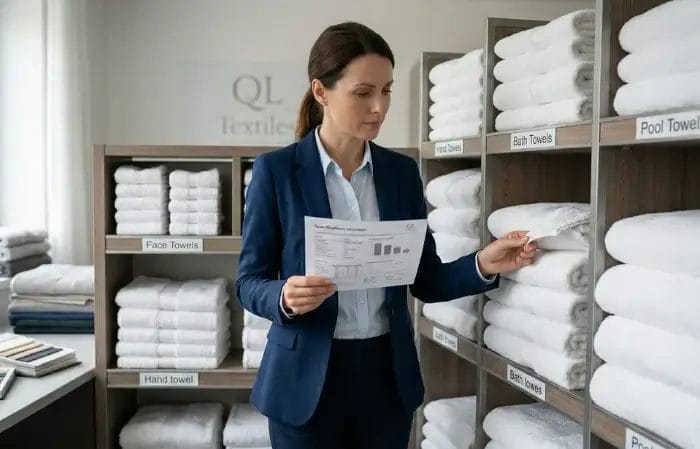
Explore our range of hotel and spa towels to compare GSM tiers across hotel bathrooms, spa operations, and pool programs. Seeing multiple weights side by side helps align guest expectations with laundry capacity, then standardize specs across properties for consistent reorders.

Towel Gsm Recommendations by Use Case
GSM ranges by towel category
The ranges below are practical starting points. Your ideal range depends on positioning, laundry capacity, and replacement cadence.
| Towel type | Typical use | Recommended GSM range | Notes for hotels and spas |
| Face towel | Guest bath, spa wipe-down | 400 to 550 | Strong turnover balance with a substantial feel |
| Hand towel | Guest bath, public restroom | 400 to 550 | Check hems and edge wear in high-traffic areas |
| Bath towel | Guest room core towel | 500 to 700 | Higher GSM feels premium but increases drying time |
| Bath sheet | Premium guest experience | 550 to 750 | Plush feel, heavier loads, longer turnaround |
| Spa treatment towel | Treatment rooms | 350 to 500 | Prioritize low lint and consistent sizing for speed |
| Pool towel | Pool and beach | 450 to 650 | Consider snag resistance and color durability near chlorine |
| Bath mat | Guest bath floor | 700 to 1000 | Evaluate backing and construction for safe performance |

Fit for Commercial Laundries
Absorbency vs dry time
Higher GSM can improve plushness and water holding capacity, but it also increases drying time, energy use, and load weight. The best towel meets guest expectations and still cycles smoothly through your laundry operation. Select a GSM range your dryers can handle without creating bottlenecks during peak occupancy.
Durability in real operations
Durability shows up after repeated wash and dry cycles. Common issues include loop pulls, fraying at edges and borders, hem failures, thinning, and GSM loss as fibers wear down. During receiving, check batch consistency in size, weight, and stitching. A towel can look excellent on day one but fail early if hems are weak or borders are poorly reinforced.
Care and replacement planning
Care guidance should match both the towel design and the department using it. Overdrying accelerates fiber damage and increases lint, while aggressive chemistry can shorten towel life and dull colors. Replacement planning works best when you track rejects by towel type and department. Guest-room, spa, and pool towels often have different wear patterns even within the same property.
Conclusion
GSM is a useful way to tier towels, but it works best when paired with fiber content, loop structure, and commercial laundry constraints. Choose GSM ranges by department needs, dryer capacity, and durability targets rather than assuming heavier is better. Request a quote at QL Textiles contact and include towel type, size, target GSM, quantities, color, branding needs, and delivery location to speed up sourcing.
FAQs
What is a good GSM for bath towels?
For many hotels, 500 to 700 GSM is practical. Lower GSM dries faster, while higher GSM feels more plush.
Is 600 GSM good for a towel?
Yes. 600 GSM is a common premium standard for bath towels. Confirm your laundry operation can handle the added drying time and load weight.
What GSM is best for hotel towels?
Many hotels use 500 to 650 GSM for bath towels and 400 to 550 GSM for hand and face towels. Final selection depends on brand positioning and laundry throughput.
What GSM is best for spa towels?
Many spas prefer 350 to 500 GSM for treatment towels to support fast turnover. Higher GSM can work well in relaxation areas where plushness matters.
Does GSM affect drying time in commercial laundries?
Yes. Higher GSM generally increases drying time and energy use. The impact also depends on fiber, loop density, and dryer loading practices.
Why do two towels with the same GSM feel different?
GSM measures weight per area, not construction. Yarn type, loop density, finishing, borders, and fiber composition can change softness, absorbency, and durability at the same GSM.
How much shrinkage is acceptable after washing?
It varies by fiber and construction. Define an acceptable shrinkage range in your purchase spec and confirm it with pre-production wash testing under your laundering conditions.
Conclusion
GSM is one of the fastest ways to compare towel weight when buying for hotels and spas. Used correctly, it
Leave a Comment
 Mar 11, 2026
